Itech APPLICATION NOTE – SOLAR INVERTER TESTING
Solar inverters play a crucial role in solar energy systems by converting the direct current (DC) electricity generated by solar panels into alternating current (AC) electricity, which is usable for most household and industrial applications, some common applications of solar inverters: Residential Solar Systems, Commercial and Industrial Solar Systems, Utility-Scale Solar Farms, Hybrid Solar Systems, Off-Grid Solar Systems
What is a Solar Inverter?
A solar inverter, also known as a photovoltaic (PV) inverter, is a device that converts the direct current (DC) electricity generated by solar panels into alternating current (AC) electricity. This conversion is essential because most household appliances and the electrical grid operate on AC power. Without a solar inverter, the electricity generated by the solar panels would be unusable for most applications.
How important is the efficiency of a solar inverter?
Efficiency is critical because it determines how much solar energy is converted into usable electricity. Higher efficiency means more electricity generated from the same amount of sunlight, maximizing the return on investment in solar panels.
Functions of a Solar Inverter
DC to AC Conversion
Primary Function: The main role of a solar inverter is to convert the DC electricity produced by solar panels into
AC electricity, making it compatible with household appliances and the electrical grid.
Maximum Power Point Tracking (MPPT)
Optimization: Solar inverters use MPPT technology to ensure that the solar panels operate at their optimal power output.
This involves constantly adjusting the load to maintain the maximum power point, thereby maximizing the efficiency of the solar system. Grid’s voltage and frequency. This is crucial for maintaining stability and safety in the electrical system.
System Monitoring and Data Collection
Performance Tracking: Modern solar inverters often come equipped with monitoring capabilities that track the performance of
the solar system. This includes data on energy production, system efficiency, and potential issues, which can be accessed via remote
monitoring systems.
Safety Functions
Protection Mechanisms: Solar inverters are designed with several safety features, including anti-islanding protection, ground fault protection, and arc fault detection, to ensure the safe operation of the solar power system.
Applications of Solar Inverters
Residential Solar Systems
Home Use: Solar inverters are widely used in residential solar installations, converting the solar energy collected by rooftop panels
into usable electricity for homes. They help homeowners reduce their reliance on the grid and lower electricity bills.
Commercial and Industrial Solar Systems
Large-Scale Operations: In commercial and industrial settings, solar inverters are employed to manage larger solar installations.
These inverters handle higher power outputs and are designed to support the energy needs of businesses and manufacturing facilities.
Utility-Scale Solar Farms
Grid Integration: Utility-scale solar farms utilize high-capacity inverters to convert the massive amounts of DC electricity generated
by extensive arrays of solar panels into AC electricity, which is then fed into the national grid.
Hybrid Solar Systems
Energy Storage Integration: Hybrid inverters are used in systems that combine solar panels with energy storage solutions
such as batteries. These inverters manage the flow of electricity between the panels, batteries, and the grid, ensuring efficient
energy storage and usage.
Off-Grid Solar Systems
Remote Areas: Off-grid solar inverters are essential for remote locations where there is no access to the electrical grid.
These inverters enable the use of solar energy to power homes, cabins, and other facilities independent of the grid.
ITECH provides professional testing solutions for global renewable energy development. Currently, ITECH offers a new generation of grid simulators, battery simulators, PV simulators, AC/DC electronic loads and bidirectional DC power supplies with high power density, high speed and energy regeneration for tests of renewable power generation. In addition, ITECH offers the solar array simulation SAS1000 and the energy storage battery characteristic curve simulation software BSS2000, which reproduces the real power generation curve waveform. Its modular design and flexible power extension allow you to switch freely between low-power string inverters and high-power grid-connected inverters.
ITECH Test Solution – Recommended Product
Solar Inverters test
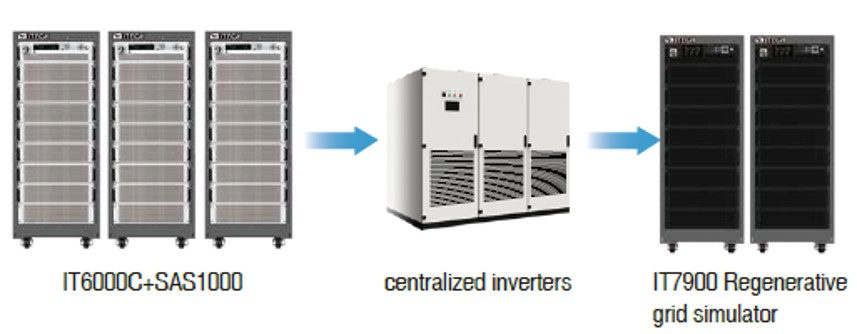
Itech IT6000C/IT6600C High power Bidirectional DC power supply
- 18kW in 3U height, Pmax.2MW, no loss after parallel connection
- 42KW in 3U height, Pmax.10MW, no loss after parallel connection
- Voltage: 800V/1200/1600/1500/2250
- Dynamic response: <2ms
Itech SAS1000 Solar array simulation software (single channel)
- Simulation of I-V curves under different temperature/irradiation/shading conditions
- Provide different curve editing modes such as built-in regulation/Table/Program/List mode
Real-time display of MPPT efficiency
ØMicro-Inverter test
Itech IT-M3600/IT-M3900C + Solar array simulation software
- Only 1U half rack, Pmax.800W (IT-M3600)
- 6kW in 1U unit (IT-M3900C)
- Voltage: 60V~600V
- Fast dynamic response, low ripple, voltage measurement accuracy up to
- 0.03%+0.03%FS
- Built-in four-point method PV simulation (Voc/Isc/Vmp/Imp)
- CC/CV priority, matching different characteristics of micro-inverse test
Itech SAS1000L (single channel)/SAS1000M(multi-channel) solar array simulation software
- Multi-channel SAS supports MPPT testing of 20 DUTs
- Simulation of output characteristics of various solar cells
- (monocrystalline/polysilicon/thin film)
- Support dynamic/static MPPT testing under different regulatory standards
Itech IT7900/IT7900P regenerative grid simulator
- High power density design, 3U up to 15kVA in 3U height, power extended to 960kVA
- Built-in anti-islanding protection test function, simplifying wiring and improving test efficiency
- Simulate phase loss/three-phase unbalance/harmonic injection/voltage transient drop waveforms
Clear display of waveform/harmonic/meter measurement results
ØPower optimizer test
Itech IT-M3900C + SAS Low power PV simulator
- Pmax. 6kW in 1U height
- Fast dynamic response <1ms, CC/CV priority
Support dynamic/static MPPPT testing under different regulatory standards
ØBattery Test
Ø
Itech IT6000C/IT-M3900C – Bidirectional DC power supply
- Battery charge/discharge test
- Battery cycle test
Battery simulation – Itech IT6000C/IT-M3900C +BSS2000
- Battery simulation software BSS2000, built-in lithium iron phosphate / lithium ternary battery curve
- Customizable battery initial SOC, initial voltage or initial capacity to enhance testing efficiency
Built-in CAN/LAN/USB
Itech Grid Tie Solar Inverter test
ØTest Requirements
- Verify the performance of PV energy Storage devices in diffèrent mode(solar only, grid first, solar first, Hybrid)
- Verify the over voltage and undervoltage of the DUT, overload protection and short-circuit protection
- Verify the MPPT efficiency of theDUT
- Verify the grid-connected performance of the DUT
ØRecommended Models
Regenerative and Bidirectional DC power supply – Itech IT6000C/IT6600C/IT-M3900C+SAS
- Bidirectional, seamless current switching, power regeneration max. 95%
- 1 test instrument can be used for both battery simulator and PV simulator
- CC/CV priority
- Fast dynamic response <2ms
Max. voltage is up to 2250V, max. power is up to 10MW
ØRegenerative Grid simulator IT7900/IT7900P
- High power density design, 3U up to 15kVA in 3U height, power extended to 960kVA
- Built-in anti-islanding protection test function, simplifying wiring and improving test efficiency
- Simulate phase loss/three-phase unbalance/harmonic injection/voltage transient drop waveforms
- Clear display of waveform/harmonic/meter measurement results
- IT7900 combines RLC Load and grid simulator functions in one which simplifies the test parameters like P/QL/Qc or RLC can be set individually for each phase
- Islanding protection time can be measured
ØRegenerative AC Electronic load Itech IT8200
- Simulate all kinds of inductive, capacitive and resistive loads
- Modular design, support single-phase/three-phase mode, flexible switching
- 3U up to 15kVA, regenerative efficiency is up to 95% max.
- Graphical waveform and data measurement function, easy to check the test results